


The number you are told is inflation is not the number you live.
BLS says consumer prices rose 3.4% over the twelve months ending August 2026. The Fed’s target is 2% and has been since January 2012, when the FOMC first wrote it down. For most of the decade before 2021, the Fed’s public complaint was that inflation was running too low. Now go buy groceries. Pay rent. Open a house listing. You already know the lived number and the reported number are not the same number. Your instinct is right. What most people are missing is why.
Here is what CPI actually measures, why it is built to read low, why the target itself is a policy of debasement, and how to measure your own purchasing power against things nobody can print. At the end I put Bitcoin on the same ruler, because that is the whole reason I write this.
Adding Inches to the Ruler
Start with the misconception, because it is the one my parents’ generation cannot get past. You have probably had this argument at a dinner table.
If you are six feet tall and I add inches to the ruler, you did not get taller. You got measured with a worse tool. That is what happens to every paycheck, price tag, and account balance denominated in dollars. A dollar is the unit. The unit shrinks. Everything measured with it reads bigger. Someone earning $110,000 today is not richer than someone who earned $110,000 in 2006. They are being measured with a ruler that has lost about 40% of its length by the government’s own count, and a lot more by any harder count.
Lyn Alden’s version is a carpenter whose measuring tools shrink a little every month: a piece cut to thirty centimeters last year no longer fits a piece cut to ten centimeters today, and the carpenter’s old inventory becomes scrap. Ammous comes at it from the other direction in The Fiat Standard: time has seconds, weight has grams, length has meters, and all three are fixed by reference to something outside themselves. The dollar measures nothing fixed. CPI is an attempt to measure the shrinkage of the unit using the unit itself. There is no external reference. It is a bathroom scale that weighs itself and reports good news. Understand that before you get into any argument about methodology.
What CPI Is, and What It Is Built to Do
CPI is a basket. BLS statisticians pick a set of goods and services meant to represent an urban household’s spending, price them every month, and report the change. Every major revision to how that basket gets built has moved the reported number down. That is the record, not an accusation. Watch the pattern.
In 1983, house prices came out. Housing went in instead as “owners’ equivalent rent,” an estimate of what you would pay to rent your own house from yourself. I have never met anyone who does this, but the index assumes you do. A house is treated as an investment, not a cost of living. Shelter is roughly a third of the index, and the part of shelter that decides whether a family can actually buy a home is not in it.
In 1996, the Boskin Commission, appointed by the Senate Finance Committee, concluded CPI overstated the cost of living by about 1.1 percentage points a year. Its report said, in plain language, that fixing this “would also contribute importantly to reductions in future federal budget deficits and the national debt,” because Social Security cost-of-living adjustments and tax bracket indexing both ride on CPI. Lower CPI means smaller benefit increases and more of your income taxed at higher brackets. The commission was not hiding the motive. It printed it.
In 1999, BLS adopted a geometric-mean formula for most categories, which builds in the assumption that when steak gets expensive you buy chicken. The technical term is substitution. Ammous’s version is the ribeye and the soy burger: your wage stays at ten dollars, the steak goes to a hundred, you eat the ten-dollar burger, the basket still costs ten dollars, and the index reports no inflation. Congratulations. You are a vegetarian now, and it was your idea. The basket is not measuring the same life. It is measuring the cheaper life you got pushed into.
Through the late 1990s, “hedonic” quality adjustment expanded. If this year’s laptop has twice the storage of last year’s at the same price, the index books a price decline. Some of that is defensible. The problem is which direction it runs. The things that get better and cheaper through technology, electronics above all, pull the index down. The things that cannot be mass-produced, a house near a job, a year of college, an hour of a doctor’s time, a ribeye, pull it up. Michael Saylor’s framing in the Saylor Series is the right one: inflation is not a number, it is a vector. Every good has its own rate, and the goods people actually want, scarce real estate, early retirement, the assets that throw off income, inflate at the rate of the money supply, not the rate of the CPI.
Then there is “core” inflation, the version that strips out food and energy. Ammous, citing the economist Stephen Roach, who was at the Fed at the time, records that Chairman Arthur Burns in the 1970s fought inflation by removing from the index whatever was rising, always with a non-monetary explanation for the rise, until about 65% of the original basket was gone. Core inflation is the descendant of that project. It excludes the two categories a household cannot substitute away from. Try going a month without either and see how core you feel.
None of this makes CPI a fabrication. It is an honest measurement of a specific, shrinking, quality-adjusted, substitution-adjusted basket. What it is not is a measurement of what it costs to live the life you lived ten years ago, and it was never designed to be. The institution that publishes it is the same institution whose benefit payments, debt service, and political standing all improve when it reads low. That is not a conspiracy. It is an incentive, and incentives work.
The Target Is the Policy
Take 2% at face value and it is still not stability. Alden does the arithmetic: at 2% a year, prices double every 35 years. Start working at 22, retire at 67, and you watch the price of everything double, then start doubling again, over one career. That is if they hit the target. Since 1971, CPI is up more than eightfold. They did not hit the target.
Alden’s other point is the one the target’s defenders never answer. Productivity pushes prices down. Better tools, cheaper energy, more efficient factories should make things cost less every year, the way televisions and computers do. A 2% target means the central bank commits to printing enough new money each year to overwhelm those gains and keep prices rising anyway. Call it what it is, a debasement target, and every central banker statement lamenting “too-low inflation” through the 2010s reads the way it should. Imagine complaining that the ruler is not shrinking fast enough. They did, in writing, for a decade.
Philipp Bagus, in the PRDV151 material, names why governments prefer it: monetary expansion is a tax that never appears on a ballot. It funds spending without a vote, and the bill arrives years later at the grocery store, blamed on everything but the money.
Rulers That Do Not Stretch
If the dollar cannot measure itself, measure it against things that cannot be printed. Here is what has happened to the main yardsticks since 1971, the year Nixon cut the dollar’s last link to gold.
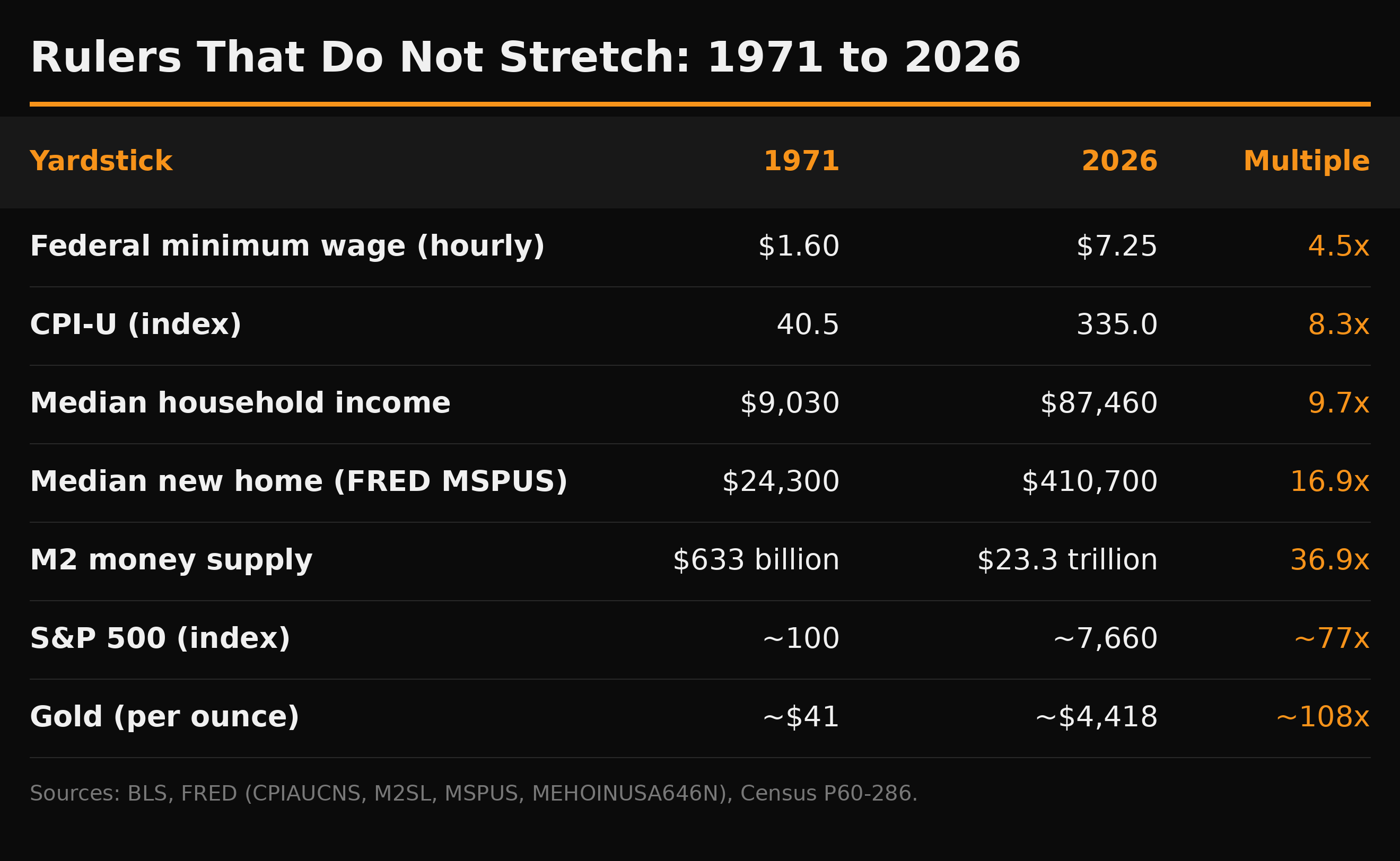
Read the table from the bottom up. The money supply grew 37 times. The things that are scarce, or that catch new money first, grew 77 to 108 times. The government’s inflation ruler grew 8 times. Wages grew 5 to 10 times. Everyone below the M2 line has been measured with the shrinking ruler and told they are doing fine.
Two of these deserve a closer look.
The 1971 minimum wage in gold. There is a number that circulates online: a 1971 minimum-wage worker’s income, converted to gold, equals about $78,880 today. That number is stale, not wrong in method. Run the arithmetic. $1.60 an hour for a full year is $3,328. At the official $35 an ounce that bought 95 ounces; at the 1971 market average of about $41 it bought 82 ounces. For $78,880 to be right, gold would have to sit between $830 and $970 an ounce. It did, in 2008 and 2009. At $4,418 an ounce in September 2026, those same ounces are worth $360,000 to $420,000. A worker earning today’s federal minimum wage takes home $15,080 a year. In gold terms, the minimum wage has lost roughly 96% of its value since 1971. In CPI terms, about 45%. The gap between those two numbers is the gap between the government’s ruler and a real one.
Housing in hours. In 1971 the median new house cost $24,300, or 15,200 hours of minimum-wage work: about seven years. In 2026 it costs $410,700, or 56,600 hours: about twenty-seven years. Against median household income the ratio went from 2.7 years to 4.7. Your parents bought a house on a wage that would not cover a car lease today, and they did not do it by being frugal. They did it with a longer ruler. Frugality was not the secret. It just makes a better story at Thanksgiving.
All the Gold Ever Mined
Jack Mallers put the cleanest version of this argument on X in September 2026: all the gold ever mined is worth less than the United States national debt. I checked it, because that is the kind of claim that usually falls apart when you do. It holds.
The World Gold Council’s count of every ounce pulled out of the ground in human history, Egypt to now, is about 222,600 tonnes as of mid-2026. Nearly all of it still exists, because gold does not rust or burn. That is 7.16 billion troy ounces. The Council valued the whole stock at about $29.0 trillion at Q2 2026 prices. Gold has kept climbing since; at the September spot of $4,418, above the price behind the Council’s own figure, the same stock comes to about $31.6 trillion. Take either number. The Treasury’s Debt to the Penny reported total public debt of $40.11 trillion on September 21, 2026. Even the narrower figure, the $32.4 trillion held by the public rather than by government trust funds, clears every ounce of gold on the planet at today’s price.
Sit with the scale for a second. Six thousand years of mining, every wedding ring, every central bank vault, every coin and bar in every safe, would not settle the obligations of one government, most of them run up since 1971. The federal debt stood near $400 billion the year Nixon closed the gold window. It has grown about a hundredfold since, which is almost exactly the multiple by which gold has repriced against the dollar over the same years. That is not a coincidence. It is the same event measured from two ends.
The United States itself holds about 8,133 tonnes, the largest official reserve on earth. At today’s price that is about $1.15 trillion, under 3% of the debt, and roughly what the Treasury now pays in interest in a single year. Fort Knox covers the interest. Once.
None of this is a case for gold. It is a case against the unit. A debt bigger than every hard asset ever produced can only be carried in a unit whose supply has no ceiling, and it can only be serviced by continuing to expand that unit. The CPI, the 2% target, the quiet redefinitions of the basket, all of it is downstream of that arithmetic. At some point the question stops being technical. We have all known it for a long time. How funny is our money?
Bitcoin on the Same Ruler
Bitcoin’s supply is fixed at 21 million by rules no government, developer, or miner can change. That makes it the first candidate in history for a unit of account nobody can add inches to. It is also young and volatile, and the honest way to use it as a yardstick is across cycles, not across months. I have watched enough of those cycles to say that with a straight face. Here is the median home and a year of minimum-wage work priced in bitcoin at the start of each period.
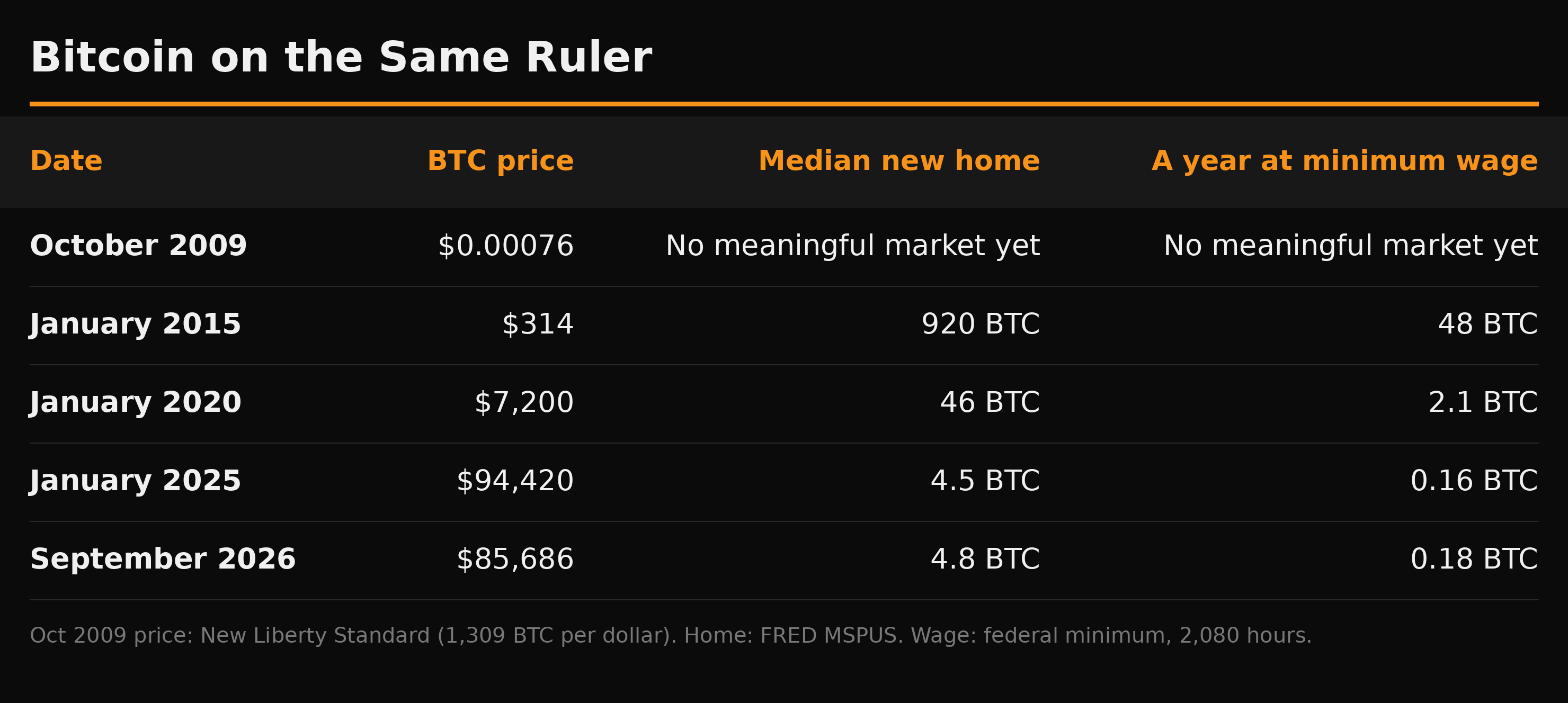
Two things to notice. First, the direction: over any span of years, everything measured in bitcoin gets cheaper, because the ruler is fixed and the dollar prices of houses and labor keep inflating around it. Second, the honesty: bitcoin is lower today than it was at the start of 2025, so a house costs slightly more bitcoin than it did twenty months ago. I am not going to pretend otherwise. A fixed-supply money is a stable ruler only once the market has finished deciding what it is worth, and that process is still underway. What it already is, today, is the one ruler whose future length is known in advance. Nobody can vote to extend it.
Why the People Who Lived It Cannot See It
Economists call it money illusion: people think in nominal terms. A raise from $60,000 to $66,000 feels like progress even in a year when the cost of living rose 12%. My parents’ generation remembers what they earned and what things cost, and the gap between those memories and today’s prices reads to them as “kids these days can’t manage money.” They are looking at the ruler and reading off the inches.
There is a second reason the illusion holds. New money does not reach everyone at once. It comes in through the banking system and the asset markets first, which is why the S&P and gold in the table above grew ten times faster than wages. The households that own assets, and the Fed’s own distributional data has the top 10% holding about 87% of equities, get measured against the long side of the ruler. The households that earn wages and hold cash get measured against the short side. The same official inflation rate describes both, and describes neither.
Measure in Something That Cannot Be Stretched
CPI is a real statistic about a fictional basket, published by the party whose obligations shrink when it reads low. The 2% target is a commitment to debase at a steady pace, and even that pace doubles prices every generation. Priced in gold, houses, hours of work, or the money supply itself, the dollar has lost far more than the index admits, and the people who feel that loss most sharply are the ones with the least exposure to the assets that catch the new money. The debt those dollars carry now exceeds every ounce of gold ever mined, and it can only be carried by a unit that keeps growing.
The fix at the household level is not to argue with the index. It is to stop measuring with it. Count your wealth in hours of your own labor, in ounces, in square feet, or in an asset whose supply is fixed by rules rather than by committee. That is the conversation I have with clients. It is also the one I would have with my parents, if they would sit still for it. Once you do, the question they keep asking, why people who make more than they did have less than they had, answers itself. Nobody got shorter. The ruler got longer.
If any of this is new to you, I am writing an eight-phase educational on money and Bitcoin that covers it from the ground up, and I am currently in Phase 4. The full series is laid out in order and separated by section at awblock.io/learn.
I recommend starting at the beginning, with What Is Money.
“I do not think it is an exaggeration to say history is largely a history of inflation, and usually of inflations engineered by governments for the gain of governments.”
— Friedrich Hayek
Sources: The Fiat Standard Ch.4, CPI and Unitless Measurement, and Ch.8 (Ammous) | The Bitcoin Standard Research Bulletin, Fiat Food (Ammous) | Broken Money, chapters on the 2% target and the shrinking-ruler carpenter (Alden) | Saylor Series Ep. 9: Inflation as a Vector (Breedlove) | PRDV151, SLP153 Philipp Bagus on inflation as hidden taxation | Boskin Commission Report (December 1996, via SSA) | BLS CPI-U, August 2026 | FRED: CPIAUCNS, M2SL, MSPUS, MEHOINUSA646N | Census P60-286 | FOMC Statement on Longer-Run Goals (January 2012) | Federal Reserve Distributional Financial Accounts | Gold price September 2026 (Fortune) | World Gold Council, How Much Gold Has Been Mined (Q2 2026) | U.S. Treasury, Debt to the Penny (September 21, 2026) | Jack Mallers, X, September 2026 | Bitcoin price history (in2013dollars; Fortune, September 23, 2026) | New Liberty Standard exchange rate, October 2009
What Is A.W. Block?
A.W. Block is a digital asset estate investigation and Bitcoin advisory firm. On the estate side, we support attorneys, probate administrators, and fiduciaries with asset identification, blockchain investigation, and court-ready documentation. On the advisory side, we work with individuals and institutions on Bitcoin custody, accumulation strategy, and education.
awblock.io
Found value? Share, subscribe, and/or send sats here: bc1qrlgzu0m94wdrsnxjg8qym7jtnudelgfypmjmaa